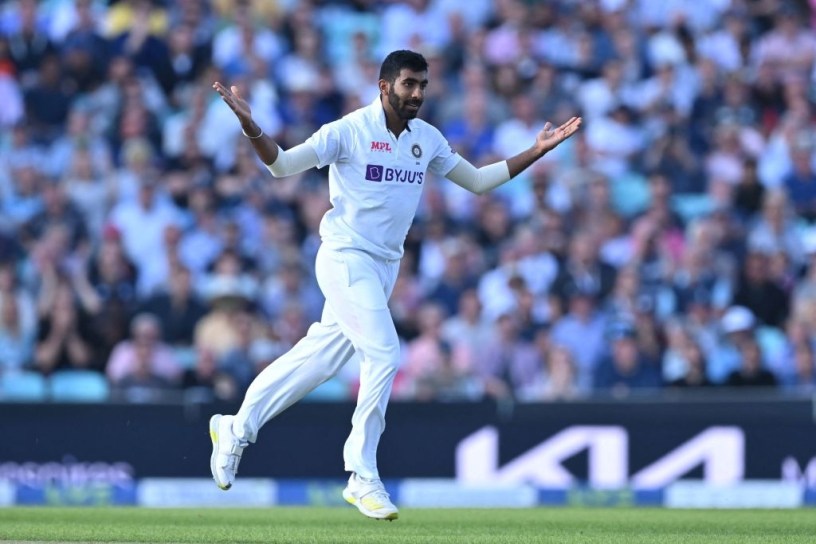
The players had just walked out after lunch when the sun was beating down The Oval as India began with the spells of Jadeja and Bumrah on either ends. The conditions were ideal for notching up hundreds and bat long. Preferably to play the ball on it’s merit to secure the draw, at least. The England batters had recorded the least false shot percentage (8%) until lunch in comparison to the the rest of the test match which told you how good the wicket was after four complete days of cricket being played on it. No signs of deterioration or uneven bounce. That was the point when you saw Bumrah steaming in, pitching the deliveries on a fuller length and trying to extract something out of the wicket like he knew about the treasure in store that the others did not. You could almost sense that the slingy-arm was about to be rewarded and there he was, after dislodging Pope’s stumps, with a smirk on a face that foresaw the outcome.
It is said that you know a bowler’s greatness is justified if he can bring life out of a flat/docile track offering nothing in return. The spell was nothing short of a reverse-swing masterclass that reminded you of a certain bowling style from the Pakistan quicks in the previous decades. Not to forget that Bumrah’s knack of producing bullseye yorkers right next to the batters’ feet, in such conditions, is a huge takeaway from the T20 format that built his reputation as a death-over specialist. At an economy of 1.22, his 22 overs yielded only as much as 27 runs. As far as the others are concerned, it was a performance where each one contributed to build the pressure upon the England batters and henceforth, take wickets. You could see immediately that India bowled much straighter lines and attacked the stumps much more when they began proceedings in the day. A graphic showed that 45% of the deliveries that India sent down were directed at the stumps in the first hour of play or so. The number is quite high in conditions where you focus on the channel outside the off-stump but applying the theory that making the batter play a higher number of balls would mean a better chance of him inducing more errors did pay off for India.
You look at Shardul Thakur, the bowler, who bowled rather erratically on day two and then on day five where he goes on to get the first breakthrough and Root’s wicket. You can never write him off with his ability to spark a moment of brilliance and switch the momentum in his team’s favor, with the bat, as well.
Ravindra Jadeja’s match figures of 4/86 in 47 overs, throughout the test, should not be underplayed. In the second innings, the lack in the flow of runs in his briskly-completed overs, caused the run out and his two wickets were deliveries that spun out of the rough area to dismiss the well-set Hameed and Ali, later.
Umesh Yadav’s comeback was as good as any. To play him on such a surface where you need the bowler to hit the deck hard and bowl quick was a master stroke by the team management and Virat. He might go for runs but the in-ducker that dismissed Root in the first essay was his way of saying “forgotten but not futile.”
Finally, the fifth day was also a huge examination of Virat, the captain. He was pro-active with his bowling changes that gave immediate results and also the field-plans like when, on a consistent basis, four close-in fielders were placed around the bat to maintain the pressure whenever Jadeja came on to bowl were signs of his growth as skipper after years of handy experience. Often criticized in the past for his team selections, Virat should be credited here for cracking the code of picking the ideal combination. Both Yadav and Shardul, being the two changes, were successful which also justified the exclusion of the highly-ranked Ashwin.
Stats courtesy – cricviz
If you enjoyed reading the article, do subscribe to us here! Do follow us on the below mentioned social media platforms as well!


Good to read your write up . 👍Again bowlers bowled them out . Indian tigers pounced fiercely , 50 years ice broken . 👍👍👍👍
LikeLike
Thank you so much🙌🏼
LikeLike
As usual superb blog as if you are watching a live coverage 👌🏼👌🏼 Our team is showing immense dedication and credit should go to the whole team. Jadeja is a great all rounder. 👊🏼👊🏼🇮🇳🇮🇳
Always waiting for your next blog. Keep writing……. 🤗🤗
LikeLiked by 1 person