
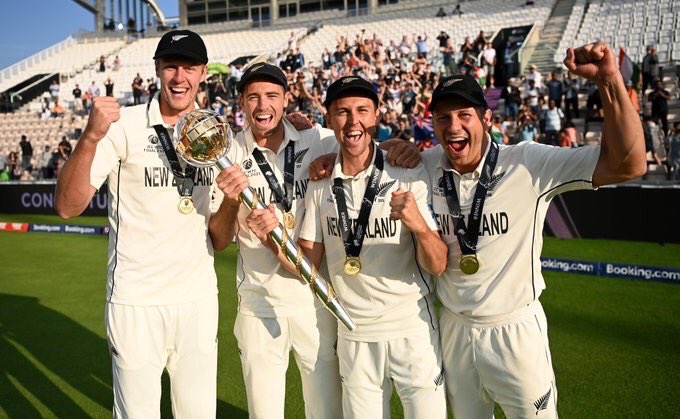
New Zealand ended their 21-year long ICC Trophy drought. They win the inaugural edition of the World Test Championship after defeating India by 8 wickets.
A game of cricket is won by the side that makes better decisions and remains pro-active throughout the course of the match, Kane Williamson and his men were clinical to say the least.
An all-out pace attack : –
New Zealand went with four quick bowlers and each of them offered something unique from the other. If Boult troubled the right-handers with the delivery that did not tail back, Jamieson was clever enough to mix his two deliveries, the one that seams away and the nip-backer, to pick the ever crucial wicket of Virat Kohli twice. Wagner’s barrage of short deliveries to specific batters was also a great tactic, forcing them out of their comfort zones and into making mistakes. Importantly, their bowlers managed to get the ball to swing unlike most of the Indian bowlers. Going in with no spinner meant that the Indian batting did not have any opening or respite from the quicks. A spinner here would have released the pressure that the quicks had created, instead of maintaining it from one end, since most of the Indian batters have a higher average against spin.
Trivia : Average swing in overs 1-5 (First innings)
NZ – 2.07 degrees, IND – 0.67 degrees (Courtesy : Cricviz)
A stable opening pair : –
Tom Latham and Devon Conway were very clear in their head regarding the game plan against the pacers. Latham left most of the deliveries outside the off-stump and scored runs when the bowler resorted to a straighter line. Before the Test match began, a statistic revealed that Devon Conway’s outside edge had been beaten only three times across four innings. Over the course of the match, it became clear why his defence was so difficult to breach. The openers adding 70 and 33 for the first wicket in the two innings ensured that the middle-order was not exposed earlier.
Cometh the hour, Cometh captain Kane : –
The sheer amount of time and the runs that Williamson scored under in such trying conditions in a final were like gold dust. For context, his 49 (177) would have been his slowest fifty in test cricket. Such an innings tired down the opposition bowling attack and that was visible when the tail was scoring freely against India. Williamson got through a tough spell from Ashwin in the second innings after two quick wickets had fallen, before guiding New Zealand to victory in a fourth-innings chase.
Trivia : Out of the 77 good length deliveries that Williamson faced, he scored 7 runs and was dismissed on one of those.
Jamieson’s impressive lengths and record vs India : –
Kyle Jamieson registered his fifth five wicket haul in his eighth test match which was the WTC Final. He finished with impressive figures of 5/61 in the match and certainly seems to enjoy playing against India.
During his debut series in 2020, he emerged as the arch-nemesis of the Indian batting line-up, playing a pivotal role in New Zealand’s 2–0 series victory at home. To go deeper into the match, he used his height to his advantage while bowling. His length was slightly fuller than that of the other bowlers, yet he managed to extract considerably more bounce from the surface. When a bowler is able to generate such bounce in conditions that are already offering swing, he becomes more than just a threat—he becomes a handful.
Jamieson’s wickets came when New Zealand needed them most: he dismissed Rohit Sharma to break a 63-run partnership on Day 2, removed Virat Kohli in both innings after repeatedly troubling him outside off stump, and claimed the crucial wicket of Cheteshwar Pujara on the reserve day, knowing how long he could occupy the crease.
The ICC Test Mace goes to New Zealand and that also means that we’ve had 7 different winners in the last 7 ICC tournaments. It’s been a wonderful test match to watch as a viewer and we can only hope that Test cricket always remains relevant.
Follow us on the social media platforms below and do subscribe to us here!

